 Crete Island Guide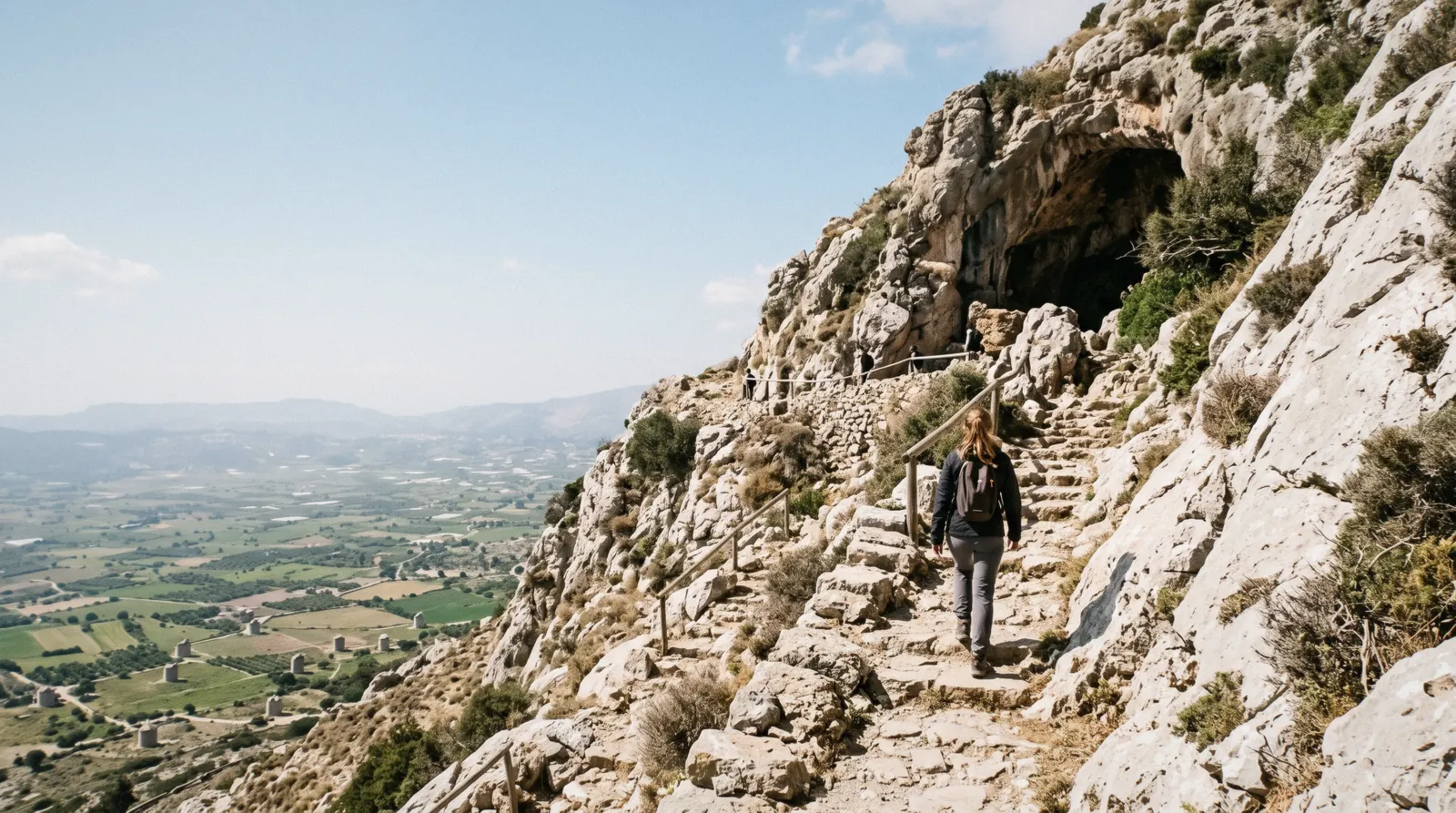
The Dikteon Cave, usually sold to visitors as the Cave of Zeus, sits above the Lasithi Plateau, a mountain-ringed farming basin still dotted with old stone windmills, one of the quieter corners of our guide to Crete, Greece. This page covers the honest price and hours, since we sell no entry ticket here ourselves, the Minoan cult finds that back up the Zeus-birth myth, and how the cave and the plateau fit into a day from Knossos.
Quick answer Cave of Zeus and Lasithi in one minute
The Dikteon Cave, above the village of Psychro on the Lasithi Plateau, is one of Minoan Crete's most important cult caves and the site ancient tradition identifies as the birthplace of Zeus. Entry costs $16.84 (€15) full price, $8.98 (€8) reduced, paid at the gate since no tour on this page sells the entry itself. The cave is open daily 10:30 to 17:30 and closed Tuesdays, a narrow window that is the usual reason people ask whether it is "closed". Inside, a steep path leads to an antechamber and a large stalactite hall, including a formation known as the Mantle of Zeus. The surrounding Lasithi Plateau still carries working and ruined stone windmills, once used to pump water for its fields.
Key takeaways
- No tour sells entry here. Pay $16.84 (€15) at the gate, or visit on a small-group day tour that includes transport and lunch.
- Go between 10:30 and 17:30, and never on a Tuesday. Outside those hours the gate is simply shut, not specially closed.
- See the plateau from the air instead. A sunrise balloon flight covers the Lasithi Plateau without the cave's steep entrance path.
- Pair it with Knossos. One day tour already strings the two together with a stop at mountain villages.
Key facts
Opening hours
| Daily, all year | 10:30–17:30 |
|---|
Closed Closed Tuesdays, plus 1 January, 25 March, 1 May, Easter Sunday, 25-26 December. 6 January, Shrove Monday and 28 October run shortened hours (08:30-15:00).
Admission
- Adult
- $16.84 (€15)
- Reduced
- $8.98 (€8), for the categories the Ministry lists
Planning it
- Time needed
- Not stated by the Ministry. Our routing: 1 hour for the cave including the approach path, half a day with the plateau.
- Book ahead
- Optional — walk-up usually fine
- Address
- Dikteon Cave, above the village of Psychro, Lasithi Plateau
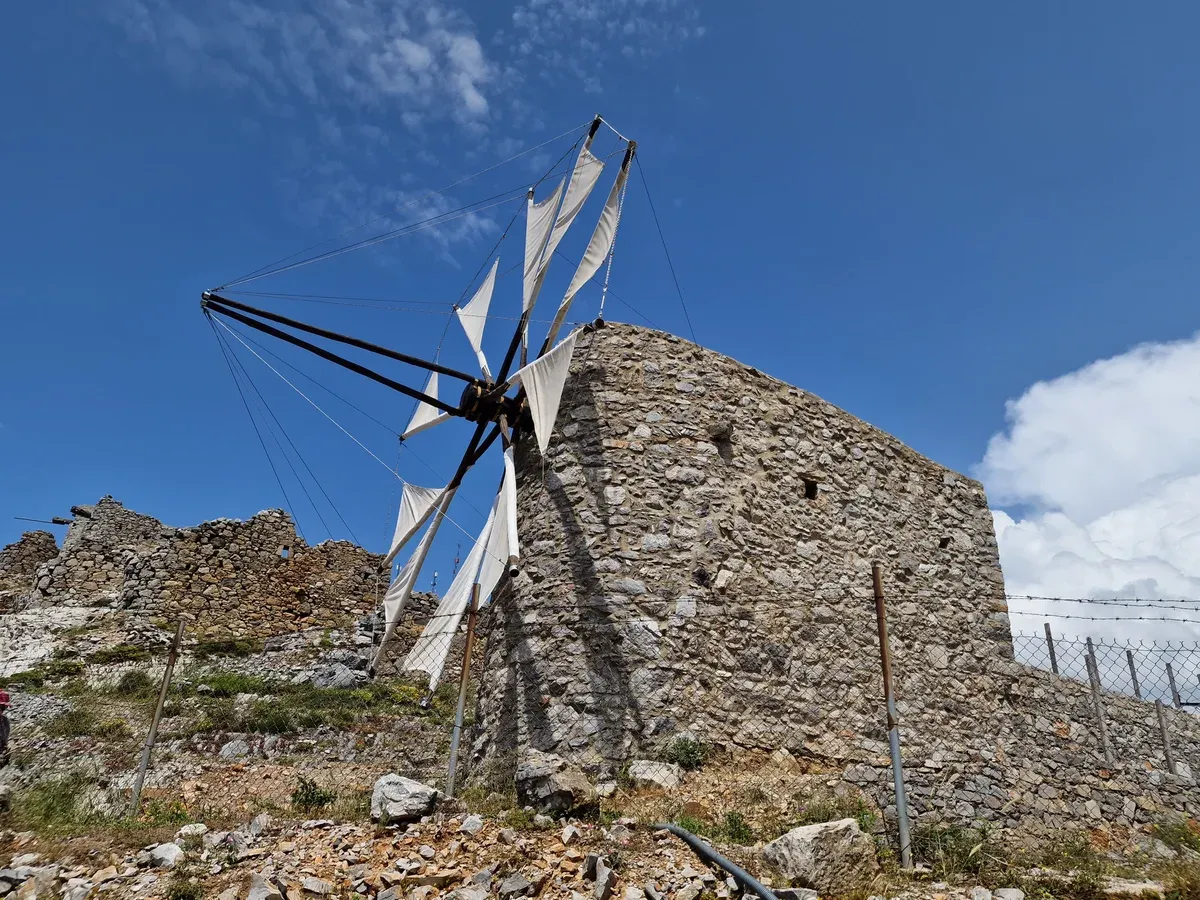
Photo: Rigorius, CC BY-SA 4.0, via Wikimedia Commons
Cave of Zeus Price
We sell no ticket for the Dikteon Cave ourselves, so the Ministry's own gate price is the price and its own page is the link.
| Where to Buy | Price | Includes | Notes | Book |
|---|---|---|---|---|
| Ministry ticket office, at the gate | $16.84 (€15) full, $8.98 (€8) reduced | Entry to the cave interior via the signed path | No advance booking; buy on arrival | Official site |
Figures are the Ministry of Culture's own published price. Figures current for Q4 2026.
See the Cave and the Plateau on a Tour
Two ways to experience this page's subject: a small-group day that actually enters the cave, or a sunrise flight over the plateau around it.
 from $102.06
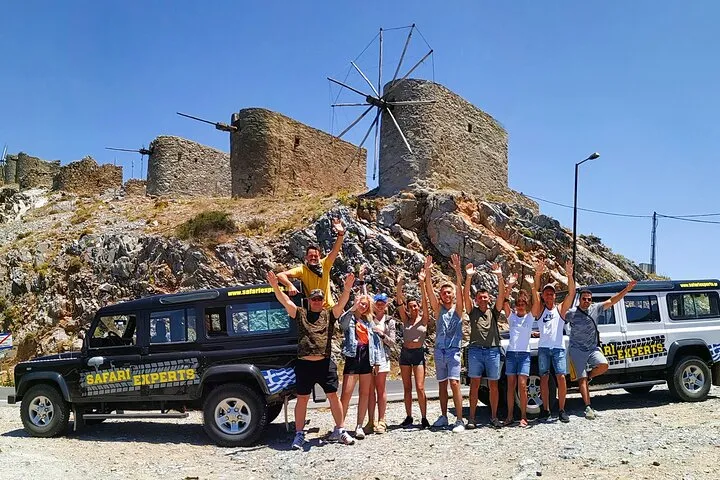
Full-Day Small-Group Tour in Crete with Zeus Cave Visit
A small-group day to the Cave of Zeus and the Lasithi Plateau from the Heraklion resorts.
Check Availability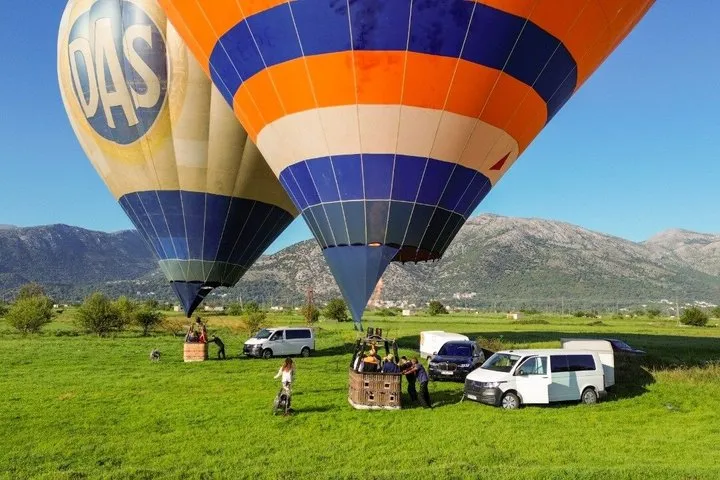 from $286.69
Sunrise Balloon Flight with Breakfast - Lasithi Plateau
A sunrise hot-air balloon flight over the Lasithi Plateau with breakfast after landing.
Check AvailabilityPrices, ratings and details are the platform's own. dollar figures are the listed prices — the platform bills in your account's currency.
What the Cave Is: Myth and Minoan Cult Site
The cave's fame rests on two things that do not always line up neatly, an ancient myth and a long archaeological record of real religious use.
The Birthplace of Zeus
Ancient tradition identifies this cave as the Diktaian Cave, where Zeus was born and raised with the help of the nymph Amaltheia and the Kouretes, according to the Ministry's own description. The site is also tied to the myth of the seer Epimenides, said to have slept here, and to stories connecting Zeus with Europa. These are presented by the Ministry as the myths attached to the cave, not as settled history.
A Real, Long-Used Cult Site
Separately from the myth, the cave was one of the most important cult places of Minoan Crete, with the use of caves for religious practice a basic feature of ancient Cretan belief. Cult practice probably began in the Early Minoan period (2800-2300 BC), with traces of even earlier occupation in the antechamber, and the most important finds date from the Middle Minoan period (around 1800 BC) onward. The cave stayed in use for centuries, through the Geometric period (8th century BC) and the Orientalising-Archaic period (7th-6th century BC), with evidence it was still visited as late as the Roman period.
Myth and cult history from the Ministry of Culture's Dikteon Cave description page.
A Century of Excavation
The cave's modern discovery reads like a list of the biggest names in early Aegean archaeology.
From Local Finds to Formal Digs
In the final decades of the 19th century, local residents found ancient objects inside the cave, which led archaeologists Joseph Hatzidakis and F. Halbherr to excavate there in 1886, though not on a large scale. Arthur Evans, before his work at Knossos made him famous, investigated the cave in 1897, and David Hogarth of the British School at Athens carried out more extensive excavations in 1899 and published the results. No fully systematic excavation has taken place since.
Where the Finds Ended Up
The objects recovered during legal and illegal excavations were almost all published in 1961 by scholar John Boardman. The numerous offerings pulled from the cave, including figurines of humans, animals and gods, and double axes, are now split between the Heraklion Archaeological Museum and the Ashmolean Museum in Oxford.
Excavation history from the Ministry of Culture's Dikteon Cave description page.
Inside the Cave: Stalactites and the Mantle of Zeus
The cave sits high enough that reaching it is part of the experience, and the interior is laid out in two distinct chambers.
The Climb and the Antechamber
At 1,025 metres above sea level, a steep path leads up to a plateau in front of the cave's narrow entrance. Just inside, an antechamber measuring about 42 by 19 metres holds a rectangular stone altar roughly a metre high, where Neolithic potsherds, Early Minoan burials and Middle Minoan offerings have all been found.
The Large Hall and the Mantle of Zeus
Beyond the antechamber, a large hall measuring about 84 by 38 metres has an inclined floor and a smaller chamber off to one side, including a niche known as the "liknon of Zeus". A further chamber to the right splits into two parts, one with a small pool and the other home to a striking stalactite formation known as the "mantle of Zeus", the cave's single most photographed feature. Most of the bronze figurines, daggers, arrowheads and double axes recovered from the site were deposited in this main chamber.
Physical description from the Ministry of Culture's Dikteon Cave description page.
The Lasithi Plateau: Windmills and the Approach
The cave sits above a high, enclosed farming plateau that is worth slowing down for on its own, not just as the road to the cave.
The Lasithi Plateau is a flat, mountain-ringed basin reached by a winding mountain road, farmed for cereals and potatoes between the surrounding peaks. Rows of white-sailed stone windmills, historically used to pump water for the plateau's fields, still stand at the Seli Ambelou pass, the plateau's northern entrance, including examples the site's own records class as "monokairos"-type mills. Most are no longer in working order, but the preserved examples at Seli Ambelou give a clear sense of how the plateau's irrigation once worked before diesel pumps replaced them. A sunrise balloon flight over the plateau is the way to see the whole basin and its windmill rows at once, without the cave's climb.
Windmill detail from the Wikimedia Commons description of the Seli Ambelou pass photograph used on this page.
Hours, Price and Why It's Sometimes "Closed"
The cave's hours are narrower than most Ministry sites on Crete, which is usually the real answer to "why is it closed".
The Daily Window
The cave opens daily from 10:30 to 17:30, a single fixed window used all year rather than stepping down by season the way Knossos and Phaistos do. It is closed every Tuesday, in addition to 1 January, 25 March, 1 May, Easter Sunday and 25-26 December. A few other dates, including 6 January, Shrove Monday and 28 October, run shortened hours of 08:30 to 15:00 rather than a full closure.
Why Visitors Ask If It's Open
We found no evidence of any special, out-of-the-ordinary closure at the time of writing. The PAA questions asking whether the cave is open generally trace back to its narrower daily window and Tuesday closure catching travellers who plan their day around the longer hours used at Knossos or Phaistos. Confirm the date against the hours above, and check the Ministry's own page directly before a long mountain drive.
Hours from the Ministry of Culture's Dikteon Cave information page.

Photo: Bachrockt, CC0, via Wikimedia Commons
Getting There
The cave and plateau sit in the mountains east of Heraklion, reached by a winding road rather than a direct highway.
Psychro village, the usual approach point, sits on the Lasithi Plateau's edge, with a signed path climbing from the village up to the cave entrance. We have no official source for drive times or bus connections, so any duration quoted for the route is an estimate rather than a published figure. Most independent visitors drive themselves or join a small-group tour that handles the mountain road, parking and the path up.
The Cave and Plateau on the Map
The cave sits above Psychro village on the Lasithi Plateau, east of Knossos and inland from Heraklion's coast.
- 1 Dikteon Cave (Cave of Zeus)The cave myth says Zeus was born in, above Psychro village. $16.84 (€15), closed Tuesdays.
- 2 Lasithi PlateauThe mountain-ringed farming basin below the cave, still dotted with stone windmills.
- 3 KnossosThe Minoan palace many day tours pair with the Cave of Zeus. $22.50 (€20).
- 4 HeraklionCrete's capital, the usual start point for a Lasithi day.
Numbers match the pins on the map.
Near the Cave of Zeus
Three ways to extend a Lasithi day in either direction.
Knossos
The Minoan palace most day tours pair with the cave, usually visited first in the morning before the mountain drive.
About an hour's drive, our estimate Check info & availabilityHeraklion Archaeological Museum
Where the Minoan offerings excavated from the cave, including figurines and double axes, are now displayed.
Same side of the island Check info & availabilityDay Trips in Crete
More island day trips to compare if the mountain drive to the plateau is one stop among several on your itinerary.
N/A Check info & availabilityCave of Zeus Questions
Why is the Cave of Zeus closed?
It most likely is not specially closed. The cave runs a narrower daily window than most Crete sites, 10:30 to 17:30, and is closed every Tuesday. Arriving outside those hours, or on a Tuesday, is the most common reason visitors find the gate shut.
Is the Cave of Zeus open now?
Check the hours above against the day and time of your visit: daily 10:30-17:30, closed Tuesdays, with a few holidays running shortened hours. We found no evidence of any additional, out-of-the-ordinary closure at the time of writing, but the Ministry's own page is the source to confirm directly before a long drive.
Is the Cave of Zeus worth visiting?
Yes, if the Minoan cult history or the Zeus myth interests you, or if you want to see the Lasithi Plateau's windmills as part of the same trip. The cave itself is a single chamber visit rather than a sprawling site, so it suits a half-day rather than a full day on its own.
What is the story behind the Cave of Zeus in Crete?
Ancient tradition holds that Zeus was born here and raised by the nymph Amaltheia and the Kouretes, hidden from his father Cronus. Archaeologically, the cave was a genuine Minoan cult site from the Early Minoan period onward, which is why actual religious offerings, not just myth, have been found inside.
How much does it cost to visit the Cave of Zeus?
$16.84 (€15) full price, $8.98 (€8) reduced, paid at the Ministry's own gate.
What is the Lasithi Plateau?
A high, mountain-ringed farming basin below the cave, reached by a winding mountain road and historically irrigated by stone windmills, some of which still stand at the Seli Ambelou pass on its northern edge.
The Cave of Zeus on Video
Cave of Zeus, Crete: What Is It Famous For?
A walkthrough of the myth and the cave's cult-site history.
Video: World with a TwistPsychro Cave, Crete: Zeus Cave, Lasithi, Walking Tour
A 2023 walking tour of the path up and the cave interior.
Video: Zameer PactyanCrete: Ruins of Knossos and the Cave of Zeus
A pairing of Knossos and the cave in one day, as many tours run it.
Video: Take Flight with ScottWe may earn a commission if you book through one of our links, at no extra cost to you. Full affiliate disclosure