 Crete Island Guide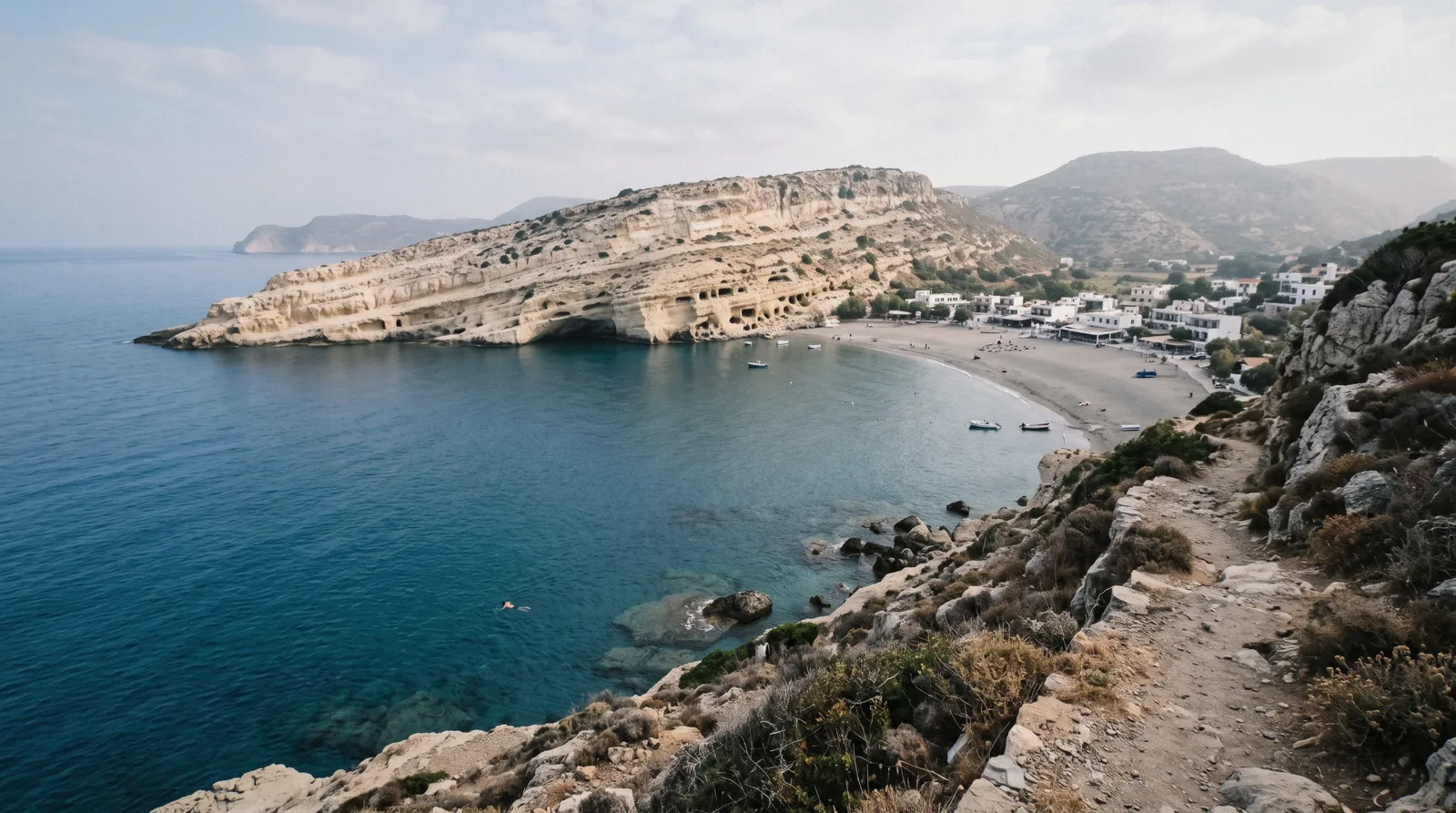
Matala is the south-coast cove where Crete's Roman-era rock-cut caves meet a free sandy beach, a combination that turned the village into a hippie landmark in the 1960s and still draws the crowds that made it famous. This guide covers what the caves actually cost to visit, the hippie history behind the name, and how Matala pairs with Phaistos and Gortyn further inland, part of our Crete Island Guide.
Quick answer Matala in one minute
Matala is a south-coast village built around a sandy beach beneath a sandstone cliff honeycombed with artificial caves, carved as far back as the Neolithic period and later used as a port, first for Minoan Phaistos and then for Roman Gortyn. The fenced caves area, managed by the Ministry of Culture as a Roman cemetery site, charges $5.61 (€5) full price and $3.37 (€3) reduced, open 10:00 to 19:00 in summer, stepping to 18:00 from October and to 08:30-15:30 in winter. The beach itself beside the caves is free and always open. The village is best known for its 1960s hippie era, when travelers lived in the caves until the church and the military junta drove them out, a history Joni Mitchell sang about after visiting in 1970.
Key takeaways
- The beach is free. Only the fenced caves area above it charges the $5.61 (€5) Ministry fee.
- Based in Heraklion without a car? A full-day tour with a winery stop covers Matala without you driving.
- Want Phaistos and Matala together? A private day from Heraklion pairs the Minoan palace with the beach and caves.
- The caves close by the clock. Plan your beach time around the 19:00 summer closing if you want to see the caves themselves.
Key facts
Opening hours
| Summer (through September) | 10:00–19:00 |
|---|---|
| From 1 October | 10:00–18:00 |
| Winter | 08:30–15:30 |
Closed None published beyond the seasonal hour changes above. The beach itself has no gate and is always open.
Planning it
- Time needed
- Not stated by the Ministry. Our estimate: half a day for the beach and the caves, more with a stop at a nearby winery or Phaistos.
- Book ahead
- Optional — walk-up usually fine
- Address
- Matala village, on the Messara plain, south coast of the Heraklion regional unit
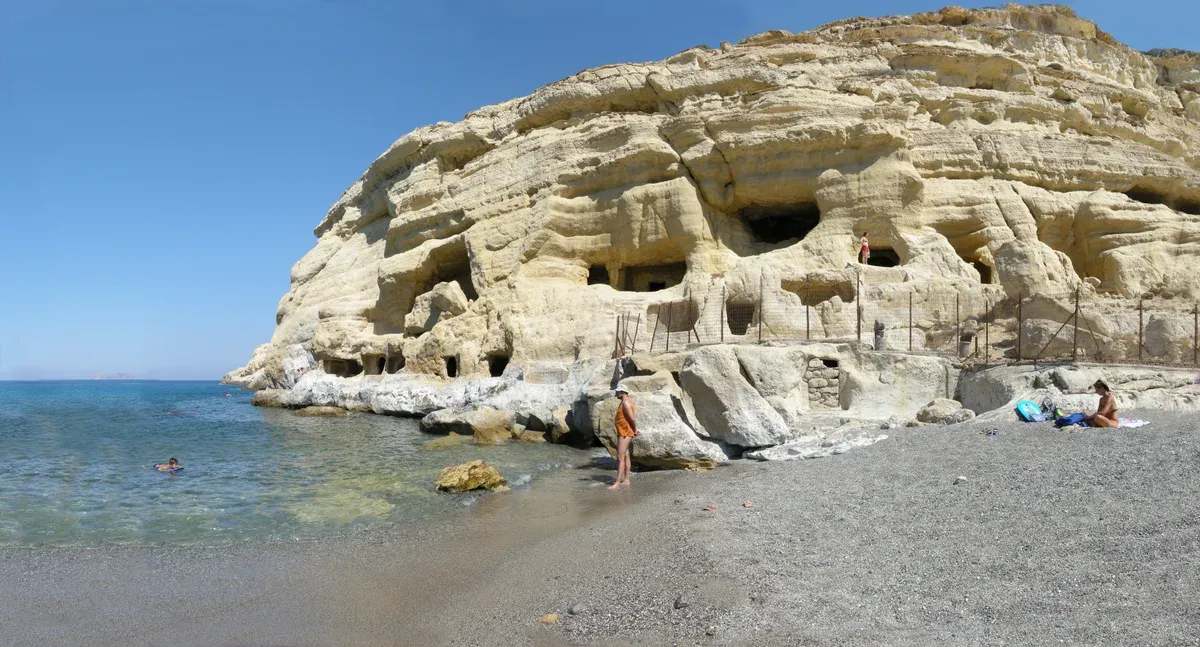
Photo: Helentr, CC BY-SA 3.0, via Wikimedia Commons
Matala Caves: The Ticket and Guided Days
The Ministry of Culture sets one gate price for the fenced caves area. Neither tour card on this page resells that ticket directly, since both are broader day trips that include free time at Matala rather than a caves-entry product.
Do you pay the Ministry's own fee at the caves gate, or let a guided day include Matala as one stop among several?
| Option | Price | Includes | Best For | Book |
|---|---|---|---|---|
| Pay at the caves gateSelf-drive beach days | $5.61 (€5) full, $3.37 (€3) reduced | Entry to the fenced Roman-cemetery caves area. The beach beside it is free and separate | Independent travelers visiting Matala on their own | Official site |
| Full-day tour with a winery stopHeraklion-based day trippers | $107.79 | A full day from Heraklion to Matala bay, a winery visit and free time at the beach and caves | Travelers based in Heraklion without a rental car | Check Availability |
| Private day with PhaistosCombining Matala with Phaistos | $94.03 | A private day pairing the Minoan palace of Phaistos with Matala beach and its caves | Travelers who want both sites without two separate trips | Check Availability |
Prices are each platform's own listed figure in US dollars. The Ministry's own caves entry is $5.61 (€5) full, $3.37 (€3) reduced. Figures current for Q4 2026.
Guided Days to Matala
Two full-day options, one from Heraklion with a winery stop, one a private day paired with Phaistos.
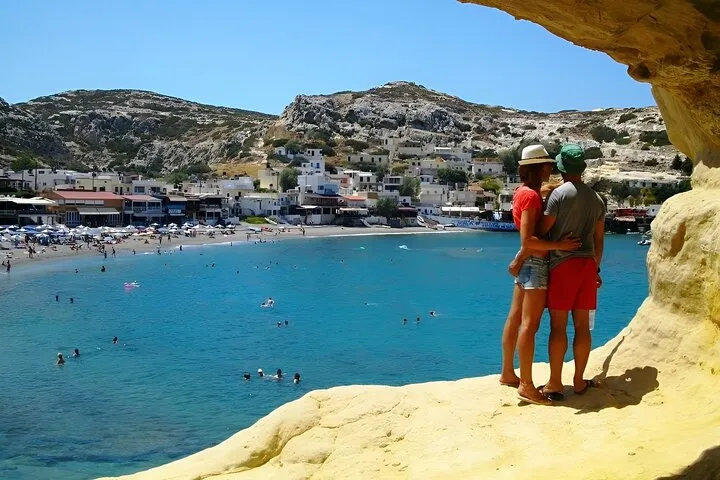 from $107.79
Matala Beach, Caves, and Winery Full-Day Tour from Heraklion
A full day from the Heraklion side to Matala bay, its Roman rock-cut caves and a winery on the way back.
Check Availability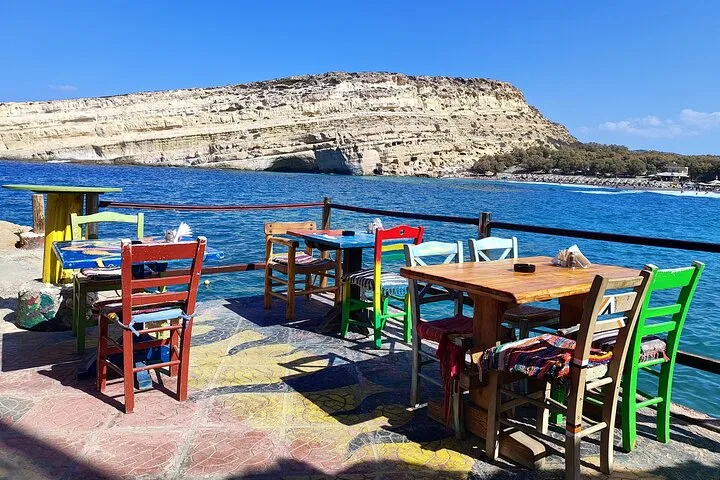 from $94.03
Matala Beach + Caves, Phaistos Palace & Southern Charm | Private
A private day to the Minoan palace of Phaistos and Matala beach with its caves, on the south side of the Messara plain.
Check AvailabilityPrices, ratings and details are the platform's own. dollar figures are the listed prices — the platform bills in your account's currency.
What Matala's Caves Actually Are
The caves are older and served more purposes than the beach-town setting suggests.
Carved in the Neolithic Age
The artificial caves above Matala beach were created in the Neolithic Age, per Wikipedia's account, making them far older than the village's modern reputation implies. During antiquity Matala served as a working port, first for Minoan Phaistos and later for Roman Gortyn, and their original purpose is still debated by historians, though their sheer volume makes residential use the more likely explanation than any more exotic theory.
The Legend of Brutospeliana
One of the caves carries the name Brutospeliana, tied by legend to the Roman general Brutus, per Wikipedia, a naming tradition rather than a confirmed historical connection. The caves' long working life as a port facility for two successive Cretan centres, Phaistos and then Gortyn, is the better-documented part of their story.
Cave origin, port history and the Brutospeliana legend from Wikipedia's entry on Matala.
The Hippie Era That Made Matala Famous
Matala's modern fame has little to do with its ancient port history and everything to do with one decade in the 20th century.
Living in the Caves
In the 1960s, the caves above the beach were occupied by hippies, who were later driven out by the church and the military junta, per Wikipedia's account of the period. The village transformed afterward into the tourist destination it is today, with gift shops and bars replacing what had briefly been an informal commune carved straight into the cliff face.
Joni Mitchell's Matala
Canadian musician Joni Mitchell spent time among the Matala hippies in early 1970, and her experiences here were immortalised in her songs "Carey" and "California," both from her 1971 album Blue, per Wikipedia. The connection still draws visitors specifically for the music history, not just the beach.
The Matala Beach Festival
Matala's hippie history is now celebrated every June at the three-day Matala Beach Festival, held annually since 2011, per Wikipedia, a modern commemoration of the era that first put the village on the map internationally.
Hippie-era history, the Joni Mitchell connection and the Matala Beach Festival from Wikipedia's entry on Matala.
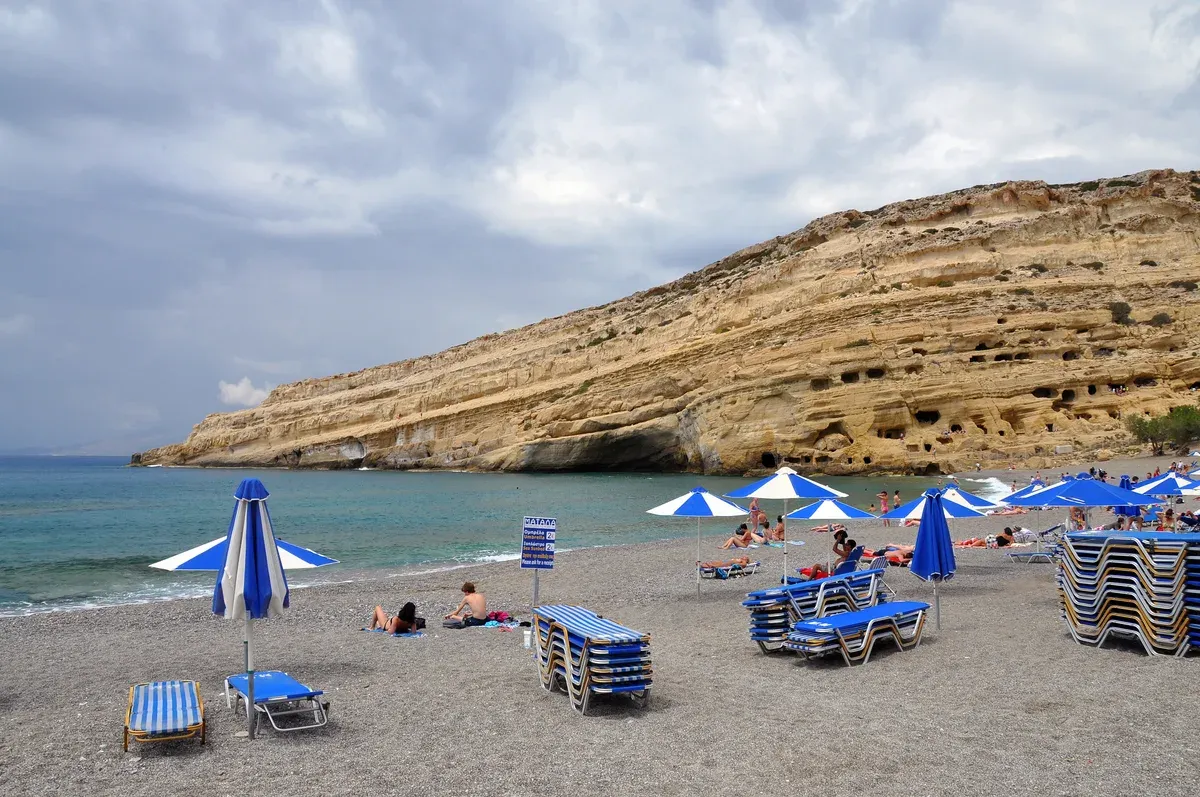
Photo: Moonik, CC BY-SA 3.0, via Wikimedia Commons
Visiting the Caves Today
The caves sit inside a managed Ministry of Culture site, separate from the free beach right beside them.
Hours and the Fee
The Ministry's Matala Roman cemetery site, which is how the caves area is officially classified, opens 10:00 to 19:00 through summer, stepping to 10:00-18:00 from 1 October and 08:30-15:30 in winter. The fee is $5.61 (€5) full price, $3.37 (€3) reduced, paid at the gate to the fenced area.
What's Inside the Fence
The ticketed area covers the cave-cut cliff face itself, fenced off from casual access to protect the site. The beach in front of it, where most visitors spend the bulk of their time swimming and sunbathing, sits outside that fence and charges nothing at all, which is why many day-trip itineraries treat Matala primarily as a beach stop with the caves as an optional add-on.
Hours and fee from the Ministry of Culture's Matala information page (odysseus.culture.gr, obj_id 2453), read 2026-10-02.
Matala Village Today
The commune that briefly made Matala famous is long gone, but the village it left behind still trades heavily on that history.
From Commune to Tourist Village
After the hippies were driven out, the village transformed into the tourist destination it is today, with gift shops and bars lining the short seafront road, per Wikipedia's account of the period. Unlike some of Crete's larger resort towns, Matala has stayed small, built around the single curve of beach and the cliff behind it rather than sprawling inland.
A Living Link to the 1960s
The hippie identity is not just a marketing line here. The annual Matala Beach Festival, running every June since 2011, keeps the connection active rather than purely historical, and several long-standing tavernas and bars in the village still trade on the era directly, with photographs and memorabilia from the period on display. Visitors who want more than a beach day can spend an hour simply walking the handful of streets behind the seafront to see how thoroughly that decade shaped the place.
A Small Footprint by Design
Matala's location at the end of a single access road, with the caves and cliff closing off one side of the bay, has kept large-scale development out in a way that has not happened at every Cretan beach town. That geography is part of why the village still feels distinct from its 1960s photographs rather than unrecognisable, and it is also why parking fills quickly on a busy summer afternoon, with most visitors leaving a car at the edge of the village and walking the last stretch down to the water.
Village history from Wikipedia's entry on Matala.
How Much Time to Give Matala
No official source states a recommended visit length. The table below is our own routing.
Every routing assumes a stop at both the beach and the caves, since the two sit side by side.
| Routing | On Site | Adds | Skips |
|---|---|---|---|
| Quick stop | 1 to 2 hours | A look at the caves and a short swim | A full beach afternoon |
| Half a day | 3 to 4 hours | Swimming time plus the caves, lunch in the village | A side trip inland |
| Full day with Phaistos | A full day | A private day adding the Minoan palace of Phaistos and Gortyn nearby | Nothing, but needs an early start |
Getting There and the Beach's Blue Flag Status
Matala sits on the Messara plain, reachable from Heraklion by a limited bus service or by road.
By KTEL Bus
KTEL Herakliou-Lasithiou runs buses from Heraklion to Matala via Moires three times a day on weekdays, 07:30, 12:45 and 14:00, with a similar three-times-daily service on weekends, per the official timetable. No fare is published on KTEL's own booking tool for this route.
A Blue Flag Beach
Matala is award #37 on the 2026 Blue Flag list for the Heraklion municipality, per blueflag.gr, a certification based on water quality and beach management that nearby Preveli, for comparison, does not currently hold.
Bus schedule from ktelherlas.gr, read 2026-10-02. Blue Flag status from blueflag.gr's 2026 Heraklion award list, read 2026-10-02.
Five Things Most Visitors Do Not Know
Quick, sourced facts for the drive back to Heraklion.
- The caves were carved as far back as the Neolithic Age, long before either the Minoans or the Romans used Matala as a working port (Wikipedia).
- Matala served as the port for two different Cretan centres in sequence, first Minoan Phaistos, then Roman Gortyn (Wikipedia).
- Joni Mitchell wrote two songs on her 1971 album Blue, "Carey" and "California," directly inspired by her time among the Matala hippies in early 1970 (Wikipedia).
- The hippies who lived in the caves in the 1960s were eventually driven out by a combination of the church and Greece's military junta government (Wikipedia).
- Matala carries the 2026 Blue Flag award, while nearby Preveli, often compared to it as a south-coast beach, does not (blueflag.gr, read 2026-10-02).
Matala in Dated Lines
A short chronology from the caves' ancient use to their modern festival, drawn from Wikipedia's sourced account.
-
Neolithic Age
The Caves Are Carved
Artificial caves are cut into the sandstone cliff above the bay, their original purpose still debated.
-
Minoan period
Port for Phaistos
Matala serves as the working port for the nearby Minoan palace of Phaistos.
-
Roman period
Port for Gortyn
The role passes to Gortyn, Crete's Roman-era capital, with one cave later named Brutospeliana after a legend linking it to the general Brutus.
-
1960s
The Hippie Commune
Travelers live in the caves until the church and the military junta drive them out.
-
1970
Joni Mitchell Visits
Her time among the Matala hippies inspires "Carey" and "California" on her 1971 album Blue.
-
2011
The Matala Beach Festival Begins
A three-day festival every June starts commemorating the village's hippie history.
Source: Wikipedia's entry on Matala.
Dos and Don'ts at Matala
Small decisions that make the day easier.
Do
- Plan your caves visit around the posted hours. They close at 19:00 in summer, earlier from October and in winter.
- Swim at the free beach even if you skip the ticketed caves area. The two are separate and the beach costs nothing.
- Pair the trip with Phaistos or Gortyn if you have a car, since both sit on the same Messara plain.
- Visit in June if the hippie history interests you. The Matala Beach Festival runs every year then.
Don't
- Don't expect the caves to be free. The $5.61 (€5) fee applies to the fenced Roman-cemetery area, separate from the open beach.
- Don't rely on a published bus fare for the Heraklion to Matala route. None is stated on the official KTEL booking tool.
- Don't confuse Matala's Blue Flag status with Preveli's. Matala holds the 2026 award, Preveli does not.
- Don't arrive at midday in peak season expecting an empty beach. Heraklion day-trip coaches cluster around then, by our observation.
Matala and the Messara Plain on the Map
Matala sits on the south coast, a short drive from the Minoan and Roman sites inland on the same plain.
- 1 MatalaThe beach and its Neolithic rock-cut caves, free to the beach, $5.61 (€5) for the fenced caves area.
- 2 PhaistosThe second-largest Minoan palace on Crete, a short drive inland on the Messara plain.
- 3 GortynCrete's Roman-era capital, the port Matala's caves once served.
Numbers match the pins on the map.
Near Matala
Two Messara plain sites that pair naturally with a Matala day.
Phaistos
The second-largest Minoan palace on Crete, on the same plain Matala once served as a port for.
Short drive inland Check info & availabilityGortyn
The Roman-era capital of Crete, the city Matala's caves later served as a port for.
Short drive inland Check info & availabilityMatala Questions
Is Matala, Greece worth visiting?
Yes, for the combination of a free beach, Neolithic-to-Roman rock-cut caves and a genuinely unusual 1960s hippie history tied to Joni Mitchell's music. It also pairs easily with Phaistos and Gortyn inland on the same Messara plain.
What is Matala famous for?
Two things: its ancient artificial caves, used as a port for Minoan Phaistos and later Roman Gortyn, and its 1960s hippie commune, which inspired two Joni Mitchell songs on her 1971 album Blue.
How much does it cost to visit Matala caves?
The Ministry of Culture charges $5.61 (€5) full price and $3.37 (€3) reduced for the fenced caves area. The beach beside it is free and has no gate.
What are the Matala caves hours?
10:00 to 19:00 through summer, stepping to 10:00-18:00 from 1 October and 08:30-15:30 in winter, per the Ministry of Culture's own information page.
Is Matala beach good for swimming?
Yes. Matala carries a 2026 Blue Flag award for water quality and beach management, and the cove beneath the caves is sheltered and popular for swimming.
What is the meaning of Matala?
The name refers to the village and bay on Crete's south coast, not a Spanish word. The caves and beach here are unrelated to any other place sharing a similar name.
Can you still see the hippie caves at Matala?
Yes. The same rock-cut caves where travelers lived in the 1960s sit inside the fenced, Ministry-managed area today, open for the $5.61 (€5) entry fee during posted hours, with the history kept alive through the village's long-standing tavernas and the annual Matala Beach Festival rather than inside the caves themselves.
Matala on Video
A Tour of Matala, Crete | Greek Island Beach Paradise
A walkthrough of the beach, the caves and the village itself.
Video: Gabriel TravelerMatala Beach and Hippie Caves | Is This the Best Beach in Crete?
A closer look at the caves and the hippie history behind them.
Video: In Between TripsDiscovering Matala Crete Greece Walking Tour
A walking tour through the village and along the waterfront.
Video: POV FreedomWe may earn a commission if you book through one of our links, at no extra cost to you. Full affiliate disclosure